Showing posts with label Who Will Win The Big Game?. Show all posts

Monday, February 5, 2018

Quant Facts now 50-28 (64.1%)

The Philadelphia Eagles upset the New England Patriots in the 2018 Super Bowl.  Our quant fact prediction was on the underdog Eagles, improving our record to 50-28 (64.1%).

https://sportsquants.kinja.com/who-will-win-the-big-game-super-bowl-lii-2018-1822595205

Our research is based on decade's worth of data in all of the major sports -- and quantifies concepts related to sports psychology and championship factors.  For almost a decade, we have published our quant fact predictions and have been correct 64.1% of the time -- sometimes picking underdogs.  This shows the power of analytics, sports psychology, and our work.  Thank you for reading.


Carlton Chin and Jay Granat have been friends and associates for many years -- and are co-authors of "Who Will Win the Big Game: A Psychological and Mathematical Approach."  


Monday, January 8, 2018

2018 College Football Championship Game

Over the past decade, we have published quant fact predictions based on our research for “Who Will Win the Big Game: A Psychological & Mathematical Approach.” Our published results have been correct over 63% of the time, often picking underdogs.


Read more here: 
https://sportsquants.kinja.com/who-will-win-the-2018-college-football-championship-1821856333


Carlton Chin holds both graduate and undergraduate degrees from MIT. He is a fund manager and quant researcher focused on portfolio strategy and sports analytics — and has worked with various sports organizations, including the Sacramento Kings. He has been quoted by the New York Times, the Wall Street Journal, and ESPN. 
Dr. Jay Granat is a psychotherapist and founder of StayInTheZone.com. He has worked with athletes of all levels, including high school athletes and Olympians. He was named one of Golf Digest’s Top Ten Mental Gurus and has been on Good Morning America, the New York Times, and ESPN. 


Tuesday, October 24, 2017

Who Will Win the 2017 World Series?

The Houston Astros and Los Angeles Dodgers have advanced to the 2017 MLB World Series. What do our “quant facts” have to say about the World Series? Before the MLB playoffs started, we used our championship factors to rank the playoff teams.
Source: MLB.
If you used the power rankings in the article to predict the winner of each playoff series, you would have gone 4-2 (correct in 4 series, wrong in 2). Since our book came out almost a decade ago, our published “quant fact predictions” have been correct about 65% of the time — sometimes picking underdogs to win championships.


Read more here: 
http://sportsquants.kinja.com/who-will-win-the-2017-world-series-1819765684


Carlton Chin, a graduate of MIT, is a fund manager and quant researcher focused on portfolio strategy and sports analytics. He has worked with various sports organizations, including the Sacramento Kings — and has been quoted by the New York Times, the Wall Street Journal, and ESPN.
Dr. Jay Granat is a psychotherapist and founder of StayInTheZone.com. He has worked with athletes of all levels, including high school athletes and Olympians. He was named one of Golf Digest’s Top Ten Mental Gurus and has been on Good Morning America, the New York Times, and ESPN. 

Thursday, January 30, 2014

Who Will Win the 2014 Super Bowl?

Here is this year's "Who Will Win" article for the Super Bowl.


Together with Dr. Jay Granat, a psychotherapist, I studied factors related to sports psychology to help predict the winner of the Super Bowl. The results are based on every Super Bowl ever played since the first Super Bowl in January 1967.

This year’s Super Bowl between the Denver Broncos and the Seattle Seahawks is a classic matchup between offense and defense.

Read more here for the Quant Fact predictions at http://www.rantsports.com/nfl/2014/01/30/2014-super-bowl-who-will-win-the-big-game/?3pt1yM4RgIXAaI26.99


If you are in a Super Bowl Square Pool, check out our updated odds for this year's Super Bowl.
http://www.rantsports.com/nfl/2014/01/27/2014-super-bowl-square-pool-probabilities-by-quarter/

Wednesday, November 9, 2011

Quoted by Bergen Record on the NY Giants' 2011 Season

"Who Will Win the Big Game?" co-author, Dr. Jay Granat, was recently quoted by the Bergen Record:

The nightmares still haunt the Giants, hiding just beneath the surface.
In Tom Coughlin’s eight seasons, the Giants are 47-17 in the first half. They are just 24-32 in the second.
AP
In Tom Coughlin’s eight seasons, the Giants are 47-17 in the first half. They are just 24-32 in the second.
The Second-Half Collapse of 2008. And 2009. And 2010.

They’re still very much with the team.

“You just try not to think about it,” linebacker Michael Boley said. “The last couple of years we’ve been known to collapse toward the end of the year.”

The Giants are off to another strong start, just as they were in 2008. And 2009. And 2010.

But no matter how big Sunday’s victory over the Patriots was, and no matter how rosy things appear at 6-2 with a two-game lead in the NFC East, the specter of another second-half fade will hang over them until they exorcise those demons.

In Tom Coughlin’s eight seasons, the Giants are 47-17 in the first half. They are just 24-32 in the second.


Jay P. Granat, a River Edge-based sports psychologist and founder of StayInTheZone.com, said the Giants have two tremendous advantages they did not have in previous seasons...


Read more here:
http://www.northjersey.com/sports/pro_sports/football/Giants_hoping_to_avoid_another_second-half_meltdown.html


Dr. Jay Granat, a psychotherapist and sports psychologist, is co-author of "Who Will Win the Big Game?  A Psychological & Mathematical Approach" with Carlton Chin, CFA, an MIT-trained "quant" and fund manager.  Granat is founder of StayInTheZone.com and Chin is chief investment officer of CARAT / Adamah Capital.  

Friday, October 7, 2011

AL Championship Series

The Detroit Tigers surprised the New York Yankees and will be facing the Texas Rangers (who defeated the Tampa Bay Rays) for the American League Championship.  Who do we think will win the 2011 AL Championship?


Let's take a look at some of the quant factors from our book, "Who Will Win the Big Game?"  (A Psychological and Mathematical Method).

  • Pitching Leadership: Favors Detroit.  Verlander had a huge season and it will be interesting to see how far he can carry the Tigers.
  • Focus, Defense & Fielding: Also favors Detroit.
  • Consistency: This factor -- based on "batting average rank" favors Texas.  This factor has one of the highest relationships to winning the World Series.
  • Big Game Experience: Favors Texas because Texas reached the World Series recently.
Overall, the factors are even (so this will not count as an "official" quant fact prediction).  However, Detroit has a bigger edge in pitching leadership and focus/fielding -- so the quant facts lean to Detroit slightly.


With the baseball playoffs in full force, there has been some interest in my new baseball book.  The book is meant to teach math to younger fans, but includes rankings of batters and greatest teams that some may like.  Please check it out:


Sunday, April 3, 2011

Quant Facts: Prediction Update

With Connecticut and Butler advancing to the NCAA Finals, that brings our book's blog's performance in published quant fact predictions to 22-11.  It is notable these methods (quantifying concepts of sports psychology) regularly predict underdogs and upsets to win sporting events (for instance, UConn in the last night's March Madness semifinal game.).


One reader pointed out that the factors in last year's NY Times article for the Final Four correctly predicted each of the semi-final and final March Madness games (all 3 games) correctly.  


Combining concepts of sports psychology with quantitative analysis can be a powerful tool.    

Wednesday, January 19, 2011

Granat Interviewed by CBS on Jets

Dr. Granat, co-author of the book, "Who Will Win the Big Game? A Psychological & Mathematical Approach," by Carlton Chin & Jay Granat, was interviewed by CBS. Granat discusses sports psychology concepts such as confidence and mental toughness. Below is an excerpt from the interview. The entire link is below, which has a video clip:

“His freewheeling style; his playful style is freeing up the players, at least this group of players to perform to their fullest potential,” Dr. Granat said.
"I think he thinks out what he’s gonna do before he does it very often. Take a second look, because you can’t argue with success,” Dr. Granat said.

And Dr. Granat said psychologically, when looking at Rex Ryan you can’t forget the impact of his legendary coach father, Buddy Ryan.

“That family style, this is the way they approach the game. They’re not soft-spoken. They’re tough. They’re probably mentally tough. They believe in themselves. And they’d rather err on the side of being overconfident than under-confident,” Dr. Granat said.

Some opponents and teams say Rex Ryan is crazy. But if you talk to a sports psychologist, what you hear is crazy … like a fox.


Tuesday, January 4, 2011

Who Will Win the College Football Championship?

Please take a look at our article on the upcoming BCS College Championship Game on Monday, January 10, 2011. Here's an excerpt:

"...our research has verified that certain key concepts of sports psychology can be used to build winning teams. Measuring factors - such as leadership, coaching, hard work, minimizing errors, and consistency - has proven to be useful in determining champions and winners. Focusing on these concepts of sports psychology can yield different results than typical sporting measures and could be interesting to sports executives as well as sports fans. Let's take a look at the "quant facts" for the BCS Championship Game featuring the top-ranked teams in college football."
Please click below for the article at Yahoo. (Published predictions on the book's blog have gone 17-9 since Carlton Chin & Jay Granat's book "Who Will Win the Big Game?" was published in early 2010.)


Sunday, November 28, 2010

Quant Facts -- Prediction Update

Our "quant facts" methods picked the World Series winner (San Francisco) after a lackluster performance in the earlier playoff rounds. Some sports fans noted that we "jumped the gun" a bit because our book's research is based on actual Championship games and series -- and not necessarily "the earlier playoff rounds."

Still, it was a fun and interesting experiment -- and our results are still a solid 17-9 in published "quant fact" predictions. The predictions are based on concepts of sports psychology that we quantify based on decades worth of data across the major US sports championships. Note that these approaches often pick teams and players that are underdogs, so that the 17-9 record is significant.

Our research shows that sports psychology concepts such as:
  • leadership,
  • coaching,
  • experience,
  • minimizing errors,
  • consistency, and
  • hard work (for example, less-glitzy skills such as defense) --
win championships. Please check out our book, "Who Will Win the Big Game? A Psychological & Mathematical Approach."

Saturday, October 16, 2010

Excerpt from Book Review

"The authors come from a point of view not normally addressed by, say, the general manager of a baseball team. In particular, the saber metric people have statistics and ideas that should help win a lot of baseball games during the regular season -- but do those same rules apply during the World Series? Apparently not! It is well known that not all wins are the same - the champions are not the team with the best regular season record - but the ones that win the important games. And it is this issue the authors address - specifically, what traits should one have to win championships. Indeed, this is a question more traditional statistics ignore and now it seems there is a way to address this important question."
"Who Will Win the Big Game?" by Jay Granat, PhD and Carlton Chin, CFA.


Sunday, September 12, 2010

Tennis US Open: Men's Final & Big Point Performance

Djokovic defeated Federer in a thrilling five-set semifinal match at the tennis US Open on Saturday (September 11, 2010). Some people said that Djokovic played the role of "spoiler" -- ruining our chances of seeing another Nadal-Federer final. Federer and Nadal are two of the all-time greats in tennis, and they have dominated men's tennis over the past few years, winning a combined 17 of 18 Grand Slam events from 2005-2009. The only final Nadal & Federer did not win over that time period was won by... Djokovic.

Nadal and Federer are truly two of the all-time greats. However, scanning the stats shows that Djokovic, at age 23, isn't far behind. His career stats are just a notch below the world's top two players.

Tennis Big Point Performance (BPP)

What does our Tennis "Big Point Performance" (BPP) say about today's finalists? Our book's tennis measure focuses on performance during big points (break points for and against). BPP has been a good predictor of the latter matches in major tennis tournaments and predicted Federer's loss in last year's final.

BPP gives a very slight edge to Djokovic in this year's US Open final. As you can see in the chart below, the semifinal match gives a tiny edge to Nadal, but using both the quarterfinals and semifinals gives the overall edge to Djokovic. Djokovic has been playing the big points consistently well.

Big Point Performance - Men's Finalists

Djokovic = + 7% and +1 in his five-set match over Federer in the Semi-Finals
Djokovic = +24% and +5 in QF match

Nadal = +13% and +2 in his semi-final match over Youzhny
Nadal = -56% and -2 in QF match

Other Factors
  • Head to head: Nadal holds the lead at 14-7, but Djokovic has prevailed in their last three meetings.
  • Surface: Djokovic has done particularly well on hard courts versus Nadal.
  • Nadal has had a great season, losing just four ATP matches in 2010 (compared to Federer's 10 and Djokovic's 12 losses this year).
Nadal is the "easy" pick, but we will go out on a limb and pick Djokovic to upset Nadal.
  • Our main "quant fact" predictor (BPP) points to Djokovic.
  • Djokovic also has other factors such as the playing surface and
  • current winning streak over Nadal.
Because Nadal has the bigger name, he is a heavy favorite at almost 3-1 odds. However, we think the match will be closer than that -- with a Djokovic upset a solid possibility.

Saturday, July 10, 2010

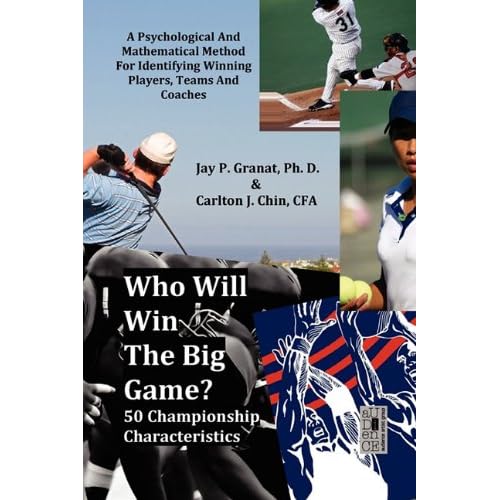
Book: Who Will Win the Big Game?


Check out our book "Who Will Win the Big Game?" -- on analytics applied to concepts of sport psychology.

Carlton J. Chin, CFA, is an MIT-trained engineer who likes to apply math and statistics to sports and the financial markets. Dr. Jay Granat is a psychotherapist who has worked with Olympic athletes.


Tuesday, April 6, 2010

Final Four Recap, Predictions & Book


Research related to our book picked Duke to win the National Championship, running our record to 13-4 for predictions posted on our blog.

Please check out our book, by clicking here.


Saturday, January 30, 2010

Football Results and Super Bowl

Our power rankings have gone 6-4 during the playoffs this year. We'll look at updated power rankings, sport psychology factors (from our book), and some other stats right before the Super Bowl.

Thanks to a reader who commented about our College Football Championship prediction being correct -- based on sport psychology factors.

Thursday, January 28, 2010

2010 Australian Open, Sport Psychology & Focus

In our book, "Who Will Win the Big Game?" we study concepts of sport psychology and try to back up these ideas with statistics. For tennis, we developed an interesting statistic that attempts to study a tennis player's focus and performance on "big points." While it is difficult to isolate specific factors in sporting events, one of our project's goals is to move forward in this direction: to measure these "elusive intangibles."

How is this measure performing during this year's Aussie Open? Starting in the fourth round of the tournament, we used our "Big Point Performance" (BPP) to predict how players might perform in the next round of the tournament. So far, this indicator has been 6-3 in men's and women's matches, starting in the quarterfinals.

The indicator correctly predicted some of these upsets:
  • N. Li over Venus Williams
  • Cilic over Roddick
  • Murray over Nadal
Some upcoming match predictions:
  • Murray over Cilic
  • Federer over Tsonga
  • Henin over S. Williams
We'll continue to track this indicator (build our database for BPP) as well as other statistics that help improve athletic performance and development.